Let’s Talk
03·RESEARCH

SemBind-Audio

Semantic-Aware Zero-Trust Audio Watermarking Framework via Transformer-Based Representation and Cryptographic Binding

A reference-based speech-watermarking study that makes embedding-location selection explicit, comparing semantic contribution and spectral suitability across the full LibriSpeech test-clean corpus.

RESEARCH BY Sanjeev Kumar·Biswajit Maity

Methodology Overview

01
Audio Input16 kHz speech
SpectrogramSTFT · 513 bins
HuBERTASTwav2vec 2.0BEATsAudioMAECLAP
Transformer-Based Semantic RepresentationHuBERT contribution map
Contribution mapFrame-level saliency
Adaptive placementFive rules compared
SHA-256 binding256-bit · 3 replicas
2,620Audio samplesLibriSpeech test-clean
40Speakerstest-clean split
5.40 hrsTotal audio16 kHz speech
100%Payload successmean · 3 replicas per bit
75.37 dBMean SNRjoint method · E1

Results & Comparison

02
MethodPayload success ↑Mean SNR (dB) ↑
Joint (Semantic + Spectral)100%75.37
Semantic-only100%73.30
Spectral-only100%77.16
Random99.96%74.25

Clean-reference E1 benchmark · n = 2,620. Random placement records one payload failure (99.96% success); joint roundtrip accuracy is 100% with three replicas per bit.

Key Contributions

04
  1. 01Inspectable self-supervised placementHuBERT leave-one-out contribution map from one forward pass.
  2. 02Controlled placement studyFive location-selection rules compared across six target SNRs.
  3. 03Cryptographic payload binding256-bit SHA-256 payload with three replicas per bit.
  4. 04Evidence-led conclusionSpectral suitability remains the stronger operational signal in current tests.
ALSO EXPLORING

Other research experience

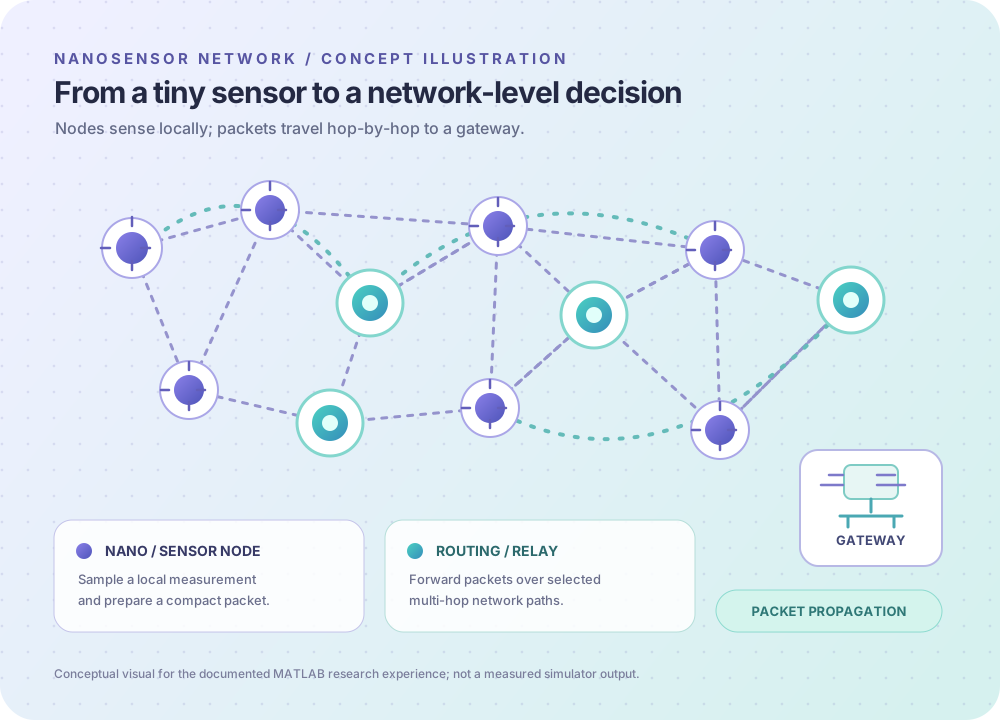
Nanosensor Network Communication Simulator

MATLAB-based research experience focused on nano-scale sensor-network communication, including routing and packet propagation.

MATLAB · Nano-scale sensor networks · Routing · Packet propagation
You arecounting…